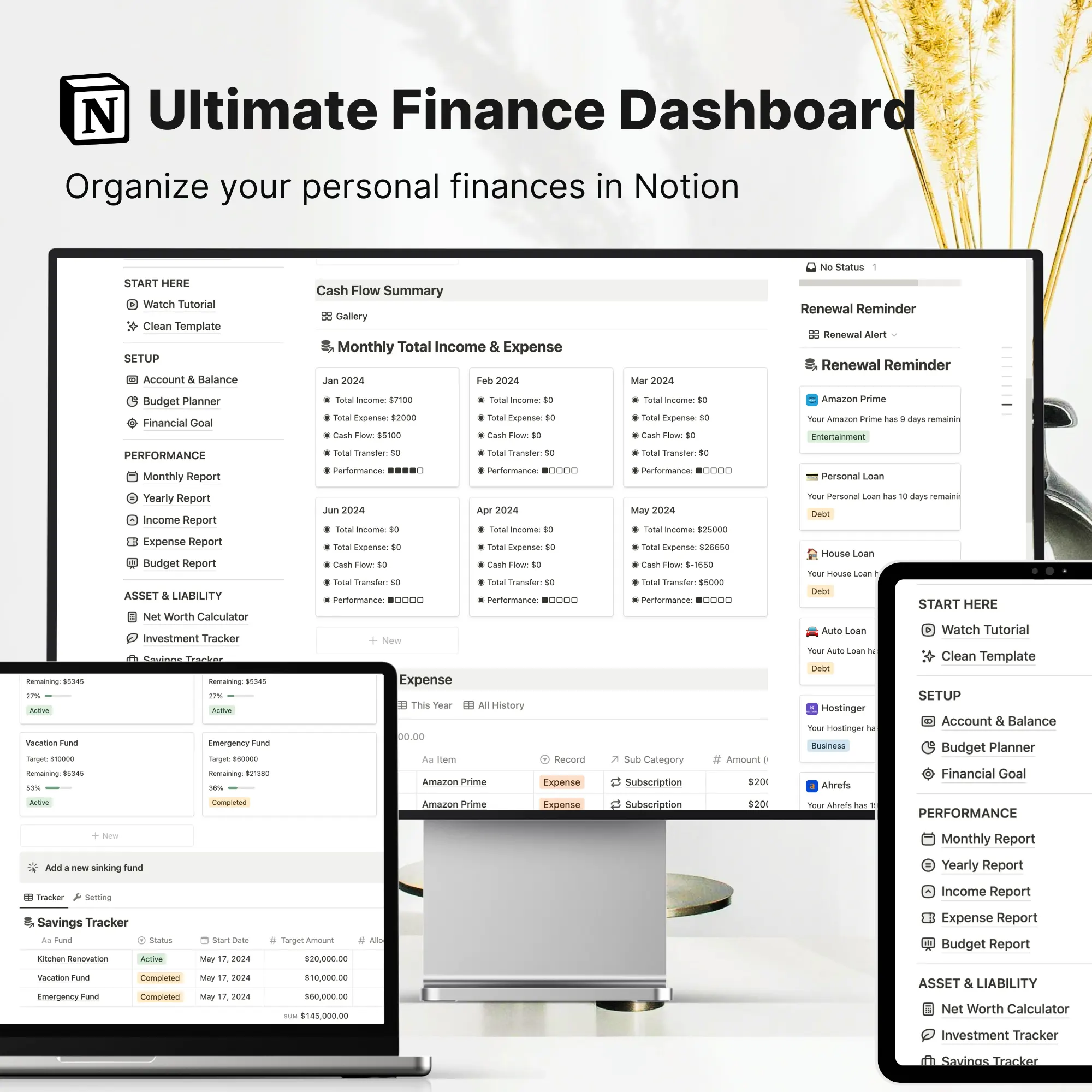
Explore the complete Notion Finance System setup →
Manage your finances in one Notion system. Track budget, expenses, and money in one place—without spreadsheets.

toc heading
Managing your finances shouldn’t feel complicated—but for most people, it is.
You switch between spreadsheets, banking apps, and notes just to track your money. Over time, this creates friction, scattered data, and no clear view of your cash flow or spending patterns.
A better approach is to use a Notion finance system—a structured way to manage your finances in one connected workspace.
Instead of juggling separate tools, you can track expenses, plan your budget, and monitor your financial goals in a single system where everything stays organized and up to date.
This page breaks down how a personal finance system in Notion works, the problems it solves, and how to decide if this approach fits your workflow.
If you prefer a visual walkthrough, this video shows how a Notion finance system works to manage your budget, track expenses, and monitor your overall finances in one place.
Instead of focusing on isolated features, it demonstrates how key parts—like expense tracking, budgeting, and account balances—connect into a single workflow that gives you a clear financial overview.
You’ll see how to manage your finances in Notion, how the system fits into a simple daily routine, and how your data updates automatically as you log transactions.
Watch the full walkthrough below to see how the system works in practice.
A Notion finance system is an all-in-one setup that helps you track expenses, manage your budget, and monitor your finances in one place.
It connects your financial data into a single workflow—so your dashboard updates automatically as you log transactions, giving you a real-time view of your income, expenses, and cash flow.
Instead of using separate tools, this system brings together your budgeting, expense tracking, and financial dashboard into one connected workspace.
This creates a clear money management workflow where everything stays accurate, up to date, and easy to maintain—without switching between apps or fixing messy spreadsheets.
Your income and expenses are organized into structured categories, making it easier to see where your money goes, analyze spending patterns, and understand how your finances evolve over time.
Using Notion for personal finance works best when you follow a simple, structured workflow instead of trying to track everything randomly. A well-designed system helps you manage your money in one place—so your data stays organized, connected, and easy to maintain over time.
At a high level, a Notion personal finance system is built around three core actions: tracking your transactions, planning your budget, and reviewing your financial data regularly. When these three steps work together, you get a clear and consistent view of your finances without relying on spreadsheets or multiple apps.
Start by recording every transaction in a structured database. This allows you to track expenses in Notion with clear categories, dates, and amounts—so your financial data stays accurate and easy to analyze over time.
→ Learn how to track expenses in Notion
Once your transactions are tracked, you can organize them into a monthly budget. This helps you control your spending before it happens, instead of reacting after the fact.
→ Set up your Notion budgeting system
A system only works if you use it consistently. By reviewing your dashboard weekly or monthly, you can spot trends, adjust your budget, and improve your financial decisions over time.
Many people struggle with the same financial challenges—not because they lack knowledge, but because their finance system doesn’t support consistent tracking or a clear workflow.
A Notion finance system solves this by giving you a structured way to manage your money—so your data stays organized, connected, and easy to maintain over time.
Without consistent tracking, it’s difficult to see spending patterns or understand your cash flow.
A structured system helps you track expenses in Notion with clarity—so every transaction is recorded, categorized, and reflected in your financial overview.
Spreadsheets often become difficult to manage as your data grows.
This system replaces scattered tabs with a structured Notion budgeting system where your budget, expenses, and accounts stay connected and organized.
Most systems fail because they’re too complex to maintain daily.
A simple and structured workflow makes it easier to stay consistent—so tracking your finances becomes a habit instead of a task you abandon.
Switching between tools creates friction and disconnected data.
A personal finance system in Notion brings everything into one place—so your budgeting, expense tracking, and financial planning work together as a single workflow.
A Notion finance system is more than a simple tracker—it’s a connected money management workflow that helps you track expenses, manage your budget, and monitor your finances in one place.
Each part of the system works together, so your data flows automatically between expense tracking, budgeting, and financial reporting—giving you a clear and real-time financial overview.
Here’s how the core modules work:
Plan your monthly spending and set a clear budget before you spend.
Instead of reacting to expenses after they happen, this helps you stay intentional and build better financial habits with a structured Notion budgeting system.
→ Explore the Notion budgeting planner
Log your daily transactions and track expenses in Notion with a simple, repeatable workflow.
Each entry is categorized automatically, helping you identify spending patterns and understand your cash flow over time.
This builds a consistent habit that improves long-term financial awareness.
Track recurring payments and manage your subscriptions in one place.
This helps you avoid unnecessary charges and gives you better control over your monthly expenses.
→ Learn how to manage recurring expenses in Notion
View your finances in one place with a Notion financial dashboard.
All your key data—income, expenses, and balances—is connected, so you always have a clear financial overview without switching tools.
Set savings targets and monitor your progress over time.
You can track how each transaction contributes toward your goals, making it easier to stay consistent and motivated.
Track loans and monitor your progress toward paying them off.
This helps you stay aware of outstanding balances, repayment progress, and how your debt impacts your overall financial position.
Monitor your investment assets and see how your money grows over time.
This gives you a simple overview of your portfolio without needing a separate tool, helping you keep everything in one system.
Track your assets and liabilities to understand your net worth.
By combining your savings, investments, and debts, you can see a clear picture of your net worth and how it changes over time.
Analyze your spending patterns and identify trends.
Instead of looking at raw data, you can quickly spot where your money is going, so you can make better financial decisions based on real data.
Tracking expenses in Notion works best when you use a structured system, not a scattered list of transactions.
Instead of manually tracking in different places, everything is organized in one database where your data stays connected and easy to manage over time.
At a high level, an effective Notion expense tracker follows three principles: recording transactions consistently, organizing them into clear categories, and connecting them to your overall budget.
This creates a system where your financial data updates automatically as you track expenses.
All expenses are logged in a centralized system, so nothing gets lost or duplicated. This gives you a clear and complete view of your spending.
→ Learn how to track expenses in Notion
Each transaction is grouped into categories, making it easier to understand where your money goes and identify spending patterns over time.
When your expenses are linked to a budgeting system, your totals update automatically—so you can compare your planned vs actual spending in real time.
A Notion finance system is designed for everyday use—no manual calculations, no complex setup, and no spreadsheets required.
Instead of spending hours managing your money, you follow a simple routine to track expenses, manage your budget, and keep your financial data up to date automatically.
Quickly track expenses in Notion in seconds using a quick-add system.
Each transaction is automatically categorized and reflected in your dashboard—so your financial overview stays accurate without extra effort.
Review your dashboard and check your spending against your budget.
This helps you spot overspending early, adjust your habits, and stay aligned with your financial plan before the month gets off track.
Review your finances and adjust your budget based on real data.
You can clearly see changes in your expenses, savings, and goals—so you can improve your financial decisions for the next month.
This structured personal finance workflow helps you stay consistent without relying on motivation.
Over time, this builds a habit where your financial data stays accurate—and your money decisions become more intentional and data-driven.
To dive deeper into specific parts of the system:
→ Track recurring bills in Notion
Building a Notion finance system requires setting up databases, relations, and workflows in a structured way.
A well-structured system ensures everything is organized and connected from the start—making it easier to track expenses, manage your budget, and monitor your finances in one place.
Instead of maintaining spreadsheets or switching between apps, you focus on managing your money through a clear and consistent personal finance workflow.
Over time, this leads to better financial awareness and more intentional decision-making.
Choosing the right tool depends on how you prefer to track expenses, manage your budget, and organize your finances.
A Notion finance system sits between spreadsheets and apps—offering both flexibility and structure in one place.
This balance makes Notion ideal for building a flexible personal finance management system
In short:
A Notion finance system gives you structure without sacrificing flexibility.
It allows you to build a connected money management system that stays organized as your finances grow—while remaining simple enough to use daily.
Yes—Notion can be a powerful tool for personal finance, but it depends on how you prefer to manage your money.
Unlike traditional finance apps or spreadsheets, Notion gives you a flexible system where you can track expenses, manage your budget, and organize your financial data in one place.
This makes it ideal for people who want a clear, customizable workflow instead of switching between multiple tools.
However, Notion is not designed to fully replace automated finance apps. It works best when you want control, structure, and visibility—rather than automatic syncing or hands-off tracking.
Notion is a strong fit if you:
This approach gives you a clearer understanding of your spending habits and financial decisions over time.
Notion may not be the best choice if you:
In these cases, traditional finance tools may be more suitable.
Not all Notion finance systems are built the same.
Many look good on the surface but fail when you try to track expenses, manage your budget, and stay consistent over time.
A well-structured Notion finance system should do more than track numbers—it should help you manage your finances through a structured and sustainable workflow.
Here’s what to look for:
Your budget, expenses, accounts, and financial dashboard should all work together.
If you need to update multiple places manually, the system breaks over time.
A well-structured system ensures your data flows automatically—so your financial overview stays accurate without extra effort.
You should be able to see your income, expenses, and overall financial position in one place.
If you need to navigate multiple pages, it creates friction and reduces consistency.
A strong financial dashboard gives you instant clarity on your money.
The system should make it easy to track expenses in Notion daily.
If logging transactions takes too long, you won’t maintain the habit.
A complete system should support:
Without these, your personal finance system becomes incomplete and harder to rely on long term.
A good Notion finance system should stay organized as your data grows.
This is the structure most well-designed Notion finance systems follow—where expense tracking, budgeting, and financial insights are all connected into one workflow:
Many Notion finance templates work initially—but become difficult to maintain over time.
They allow basic tracking but don’t provide a fully connected financial workflow.
Common issues include:
A reliable system should remain simple to use while scaling with your finances—so you can maintain consistency without friction.
A Notion finance system is ideal for people who want to track expenses, manage budgets, and organize their finances in one place—without relying on multiple tools.
Most people get started using a Notion finance template, which provides a ready-to-use system without building everything from scratch.
If you earn income, pay bills, and juggle multiple financial responsibilities, it’s easy to lose track of where your money goes.
A structured system helps you track expenses and view your full financial picture in one dashboard—without spending hours managing spreadsheets.
Credit cards, loans, subscriptions, and savings goals can quickly become overwhelming.
With a system that supports debt tracking and recurring expenses, you can clearly see what you owe, what’s due, and what you’re working toward.
If your income varies month to month, managing your finances becomes more complex.
A Notion finance system helps you track irregular income, manage flexible budgets, and stay consistent with financial tracking.
Whether you're building an emergency fund, saving for travel, or planning a major purchase, this system helps you track savings goals and monitor your progress over time.
You don’t need complex spreadsheets or multiple apps to manage your money.
A structured personal finance system in Notion helps you understand your numbers, stay consistent, and make better financial decisions with confidence.
A Notion finance system is powerful—but it’s not the right fit for everyone.
It works best if you want to track expenses, manage your budget, and organize your finances in one place using a flexible, structured workflow.
Most people implement this using a Notion finance template, which gives you a ready-to-use system without building everything from scratch.
There are many free Notion finance templates available.
They can help you get started—but most lack the structure needed to manage your finances consistently over time.
Free templates help you start.
A structured Notion finance system helps you stay consistent, maintain accurate financial data, and make better financial decisions over time.
If your current setup feels messy, inconsistent, or hard to maintain, this is where a structured Notion finance systemmakes a clear difference.
Instead of switching between tools or fixing spreadsheets, you use a system that:
If you want more clarity and consistency in managing your money, this gives you a practical way to track expenses, manage your budget, and stay in control long-term.
If you're ready to simplify how you manage your money, this Notion finance template gives you a complete, ready-to-use system.
With it, you can:
Start using a system designed to make your finances easier to manage—without spreadsheets or multiple apps.
👉 Access the Notion finance template
A Notion finance system is a structured way to track expenses, manage your budget, and organize your finances in one place.
Most people use a Notion finance template to set this up quickly without building everything from scratch.
Yes. Notion is a flexible tool for managing personal finance, including expense tracking, budgeting, and financial planning.
With a well-structured setup, you can manage everything from a single dashboard with clear visibility.
You can track expenses in Notion by logging each transaction into a database with categories, dates, and amounts.
A structured template simplifies this process with built-in views, automatic summaries, and a consistent tracking workflow.
Yes. Notion works well for budgeting when organized properly.
You can plan your budget, track spending, and monitor progress—all in one system.
For most people, yes.
A well-designed Notion finance system can replace multiple tools by combining tracking, planning, and organization into one workflow.
A good Notion finance template should include:
These features ensure your system stays organized, connected, and usable long-term.
Yes. Most templates are beginner-friendly and include guides or tutorials.
This makes it easy to start tracking expenses and managing your finances right away.
With a pre-built Notion finance template, setup typically takes less than 10 minutes.
You can start using it immediately with minimal configuration.
Yes, for general financial tracking.
However, you should avoid storing sensitive information such as bank logins or confidential financial data.
Yes, there are free Notion finance templates available.
They can help you get started, but often lack the structure needed for consistent budgeting and long-term financial management.